Marketing agencies use AI to speed up research, content planning, writing, SEO optimization, ad testing, reporting, personalization, and content refreshing. But the best agencies are not replacing strategists, writers, editors, or media buyers with AI. They are using AI as a workflow layer that handles repetitive tasks while humans manage strategy, accuracy, creativity, client context, and final approval.
That difference matters.
An agency that uses AI only to generate more content usually ends up with generic output. An agency that uses AI to improve research, structure, production, review, publishing, and performance measurement can move faster without lowering quality.
In this guide, you’ll see how marketing agencies use AI in practical day-to-day workflows, where AI helps most, where humans still need to lead, and how agencies can use AI to scale content and campaigns without losing trust.
Let’s break it down step by step.
What Is an AI Marketing Agency?
An AI marketing agency is a marketing agency that uses artificial intelligence to improve strategy, production, optimization, reporting, and campaign performance.
In practice, this can include using AI to:
- Research audiences, competitors, and search intent
- Build content briefs and topic clusters
- Draft blog posts, landing pages, emails, and ad copy
- Refresh outdated content
- Analyze campaign performance
- Personalize messaging for different audience segments
- Create reports and summaries for clients
- Improve internal workflows across teams
However, being an AI marketing agency does not mean letting AI make every decision. The strongest agencies use AI with a human-in-the-loop process. AI speeds up the work. Humans decide what is accurate, useful, strategic, and worth publishing.
Why Marketing Agencies Are Using AI Now
Agencies are under pressure from every direction.
Clients want more content, faster reporting, better performance, stronger SEO, and clearer ROI. At the same time, agency teams have to manage multiple campaigns, brand voices, approval processes, and publishing schedules.
AI helps agencies reduce the manual workload behind those tasks.
Instead of spending hours turning notes into a brief, a strategist can use AI to organize research into a first draft. Instead of writing ten ad headline variations from scratch, a media buyer can generate options and refine the strongest ones. Instead of reviewing hundreds of old blog posts manually, a content team can use AI to find pages that need updates.
The goal is not to remove people from the process. The goal is to give skilled people more time for the work that actually requires judgment.
How AI Is Changing Search, Content & Visibility
Search doesn’t work the way it used to, and marketing agencies are feeling that shift firsthand.
A few years ago, success meant ranking on page one. Today, however, visibility matters more than position. AI-driven search experiences are reshaping how users discover information, and agencies must adapt their strategies accordingly.
From Rankings to Answers: What’s Changed?
First, search engines are no longer just showing links. With Google AI Overviews (SGE) and the rise of answer engines like ChatGPT-style search, users often get answers instantly without clicking through to a website. As a result, many searches now end as zero-click searches.
This change forces agencies to rethink their approach:
- It’s no longer enough to “rank.”
- Content must be understood, trusted, and reused by AI systems
Why Traditional SEO Alone Isn’t Enough
Because AI systems rely heavily on NLP (Natural Language Processing) and entity extraction, they prioritize content that clearly demonstrates:
- Strong search intent alignment (informational, transactional, navigational)
- Clear expertise and credibility through E-E-A-T
- Structured, entity-rich information that feeds the Knowledge Graph
In other words, AI rewards clarity, depth, and usefulness, not keyword stuffing.
The New Focus: AEO, GEO & Authority
As a result, marketing agencies are expanding beyond classic SEO into:
- Answer Engine Optimization (AEO): optimizing content to be cited in AI-generated answers
- Generative Engine Optimization (GEO): ensuring content is usable by AI systems across platforms
- Topical authority building: covering subjects comprehensively, not randomly
Together, these shifts explain how marketing agencies use AI today, not just to create content, but to future-proof visibility in an AI-first search landscape.
And once agencies understand this change, the next step becomes clear: using AI intentionally across strategy, creation, and optimization to stay ahead.
Once you see how dramatically search and visibility are evolving, it becomes easier to understand why agencies are rethinking their entire approach to using AI in practice.
12 Practical Ways Marketing Agencies Use AI
Once marketing agencies move beyond experimenting with AI, they begin using it as an operational layer, not just a writing shortcut. AI now supports how agencies plan strategy, execute content, manage scale, and prove ROI, while adapting to AI-driven search environments.
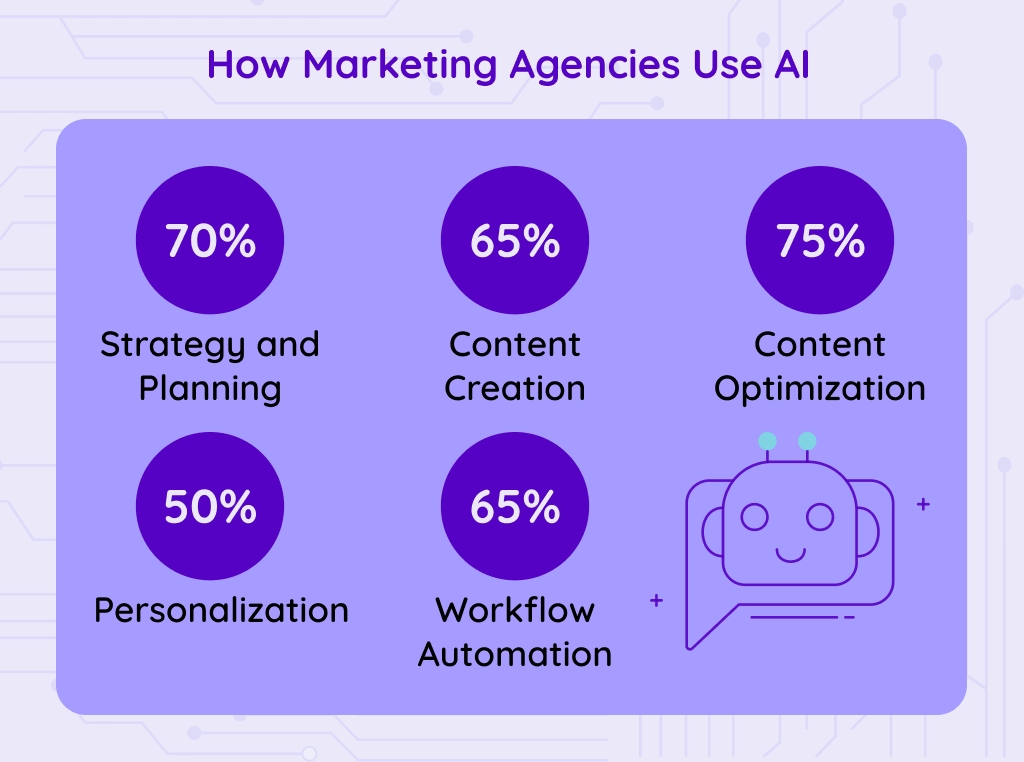
Here’s a detailed breakdown of how marketing agencies use AI in real-world workflows.
1. AI for Audience and Market Research
Before creating a campaign, agencies need to understand the audience. AI can help summarize customer reviews, survey responses, support tickets, sales call notes, social comments, and competitor messaging.
For example, a B2B SaaS agency might upload customer interview notes and ask AI to identify repeated pain points, objections, use cases, and buying triggers. The strategist can then use those insights to shape landing page copy, email messaging, and ad angles.
AI helps with:
- Finding repeated customer pain points
- Grouping audience segments
- Summarizing research notes
- Identifying objections and buying motivations
- Turning raw feedback into messaging ideas
Human role: Validate the insights, remove assumptions, and connect the research to the client’s positioning.
2. AI for Search Intent Analysis
SEO teams use AI to understand what users want when they search for a keyword. This helps agencies avoid creating content that targets a keyword but misses the actual intent.
For example, the keyword “AI marketing agency” could have multiple intents. Some users want to hire an agency. Some want to become one. Others want to understand what AI marketing services include. AI can help cluster these intents so the agency can decide whether to create a service page, educational guide, comparison article, or FAQ page.
AI helps with:
- Grouping keywords by intent
- Identifying informational, commercial, and transactional searches
- Suggesting content formats
- Comparing search result patterns
- Mapping keywords to funnel stages
Human role: Decide which intent matters most for the client’s business goal.
3. AI for Topic Clusters and Content Planning
Agencies often manage content calendars for multiple clients. AI can speed up topic planning by turning a broad theme into a structured content cluster.
For example, a content agency working with a CRM software client might build a cluster around “sales automation.” AI can suggest pillar pages, supporting blog topics, FAQs, comparison posts, glossary pages, and refresh opportunities.
A useful AI-assisted cluster might include:
| Content type | Example topic | Purpose |
|---|---|---|
| Pillar page | Sales Automation Guide | Build topical authority |
| Blog post | Sales Automation Examples | Capture informational searches |
| Comparison page | Sales Automation vs CRM Automation | Support decision-stage users |
| FAQ page | Sales Automation FAQs | Answer long-tail questions |
| Refresh task | Update old CRM workflow article | Recover lost visibility |
Human role: Prioritize topics based on business value, competition, client expertise, and conversion potential.
4. AI for Content Briefs
A strong content brief saves time for writers and improves final quality. Agencies use AI to create first-draft briefs that include target audience, search intent, headings, questions to answer, internal link suggestions, and content gaps.
For example, instead of giving a writer only the keyword “email marketing automation,” an agency can create a brief that explains the target reader, suggested angle, key sections, examples to include, and common mistakes to avoid.
AI helps with:
- Drafting outlines
- Suggesting headings
- Finding related questions
- Summarizing competitor coverage
- Creating first-draft writing instructions
Human role: Add the client’s unique perspective, product details, examples, and editorial requirements.
5. AI for First Drafts
Many agencies use AI to create first drafts for blogs, landing pages, emails, social posts, and ad copy. This works best when the agency already has a clear brief, brand voice, and review process.
For example, a content team may use AI to generate a rough blog draft from an approved outline. The writer then rewrites sections, adds examples, improves transitions, checks accuracy, and makes the content sound like the client’s brand.
This approach can reduce production time, but only when the team treats the AI draft as a starting point, not the final version.
AI helps with:
- Creating rough drafts
- Expanding outlines
- Rewriting sections for clarity
- Generating headline options
- Repurposing long content into smaller formats
Human role: Improve originality, accuracy, tone, structure, and usefulness.
6. AI for Brand Voice Consistency
Agencies often manage different brand voices across multiple clients. AI can help maintain consistency when it is trained with examples of approved content.
For example, an agency can create a brand voice guide for each client that includes tone, vocabulary, phrases to avoid, formatting preferences, audience level, and sample paragraphs. AI can then use that guide when drafting or editing content.
AI helps with:
- Applying tone guidelines
- Rewriting content to match brand style
- Checking for off-brand phrases
- Creating reusable voice prompts
- Adapting one message for different channels
Human role: Protect nuance. AI may understand patterns, but humans understand brand reputation, context, and what a client would actually approve.
7. AI for Content Refreshing
Content refreshing is one of the highest-value AI use cases for agencies. Instead of always creating new content, agencies can use AI to find and improve existing pages.
For example, an agency may review a client’s blog and identify posts with declining traffic, outdated examples, missing FAQs, weak introductions, or old screenshots. AI can help summarize what needs to change and create a refresh brief for each page.
AI helps with:
- Finding outdated sections
- Suggesting new FAQs
- Improving intros and summaries
- Comparing old content against current search intent
- Creating refresh checklists
Human role: Verify facts, update examples, add expert insight, and decide whether the page should be refreshed, merged, redirected, or removed.
8. AI for On-Page SEO Optimization
Agencies use AI to improve titles, meta descriptions, headings, internal links, schema suggestions, and page structure.
For example, after drafting a blog post, an SEO specialist can use AI to check whether the page answers the main query early, includes useful subtopics, has clear headings, and covers related questions. AI can also suggest meta title variations and FAQ ideas.
AI helps with:
- Improving meta titles and descriptions
- Finding missing subtopics
- Suggesting internal links
- Drafting FAQ sections
- Creating schema markup suggestions
Human role: Avoid over-optimization and make sure every SEO change improves the reader experience.
9. AI for Paid Ad Copy Testing
Performance marketing teams use AI to generate ad variations quickly. This is especially useful for testing different angles, benefits, calls to action, and audience segments.
For example, a paid media agency running a campaign for a project management tool can use AI to generate headline variations for freelancers, startup founders, and operations managers. The media buyer can then choose the strongest options and test them in campaigns.
AI helps with:
- Creating headline variations
- Writing ad descriptions
- Testing different value propositions
- Repurposing landing page copy into ads
- Matching copy to audience segments
Human role: Select the best angles, ensure claims are accurate, and connect copy decisions to campaign data.
10. AI for Email Marketing
Email teams use AI to create subject lines, segment-specific copy, nurture sequences, product launch emails, and re-engagement campaigns.
For example, an ecommerce agency can use AI to draft different email versions for new subscribers, repeat customers, cart abandoners, and inactive buyers. The strategist then adjusts the offers, timing, and messaging based on customer data.
AI helps with:
- Drafting email sequences
- Creating subject line options
- Personalizing email copy by segment
- Repurposing blog content into newsletters
- Summarizing campaign performance
Human role: Set the strategy, protect deliverability, check claims, and make sure the emails match the customer journey.
11. AI for Client Reporting
Reporting can take a lot of agency time. AI can help summarize campaign results, explain performance changes, and turn data into client-friendly updates.
For example, after exporting SEO, ad, or social performance data, an account manager can use AI to create a plain-English summary of what changed, what improved, what declined, and what the next actions should be.
AI helps with:
- Summarizing performance data
- Drafting monthly report notes
- Explaining traffic or conversion changes
- Creating action items
- Preparing client meeting agendas
Human role: Interpret the “why” behind performance changes and recommend the right next steps.
12. AI for Internal Agency Operations
AI is not only useful for client-facing work. Agencies also use it to improve internal processes.
For example, AI can help turn meeting transcripts into tasks, summarize client feedback, create standard operating procedures, draft onboarding documents, and organize project notes.
AI helps with:
- Summarizing meetings
- Creating task lists
- Drafting SOPs
- Organizing client feedback
- Preparing onboarding materials
Human role: Make sure internal processes are practical, clear, and aligned with how the team actually works.
A Simple AI Workflow for Marketing Agencies
The best AI workflows are not complicated. They are structured.
Here is a practical content workflow agencies can use:
| Step | AI task | Human task | Final output |
|---|---|---|---|
| 1. Research | Summarize audience, competitors, and search intent | Choose the strategic angle | Research notes |
| 2. Brief | Draft outline, headings, FAQs, and SEO notes | Add client insight and examples | Approved content brief |
| 3. Draft | Generate first draft or section drafts | Rewrite and improve originality | Editor-ready draft |
| 4. Review | Check clarity, gaps, and structure | Verify facts and brand voice | Final draft |
| 5. Optimize | Suggest title, meta, schema, and internal links | Approve SEO changes | Optimized page |
| 6. Publish | Prepare formatting and CMS-ready content | Final approval | Published content |
| 7. Refresh | Find outdated content and decay signals | Update with new insights | Improved existing asset |
How AI Fits Inside the Agency Workflow
Traditionally, agencies jumped between tools, one for research, another for writing, another for publishing, and yet another for optimization. This constant switching slows teams down and increases errors.
Modern agencies are changing that by using AI as part of a connected system powered by:
- CMS automation
- API integration
- Centralized workflows inside platforms like WordPress and the Gutenberg Editor
As a result, AI supports every stage of the content lifecycle from planning to publishing to performance tracking.
Below is how AI supports agencies step by step, without disrupting existing teams or processes.
- Strategy & Planning: AI assists with semantic SEO research, search intent analysis, and topical mapping to ensure every piece of content supports long-term authority.
- Content Production: Using AI-powered content briefs and bulk content generation, agencies move faster while maintaining brand voice consistency.
- Optimization & Structure: AI helps implement schema markup (Article, FAQ, Organization) using JSON-LD, making content easier for search engines, answer engines, and Google AI Overviews to understand.
- Quality Control: With a human-in-the-loop (HITL) approach, editors and strategists review AI-assisted content to protect E-E-A-T and ensure information gain.
- Distribution & Visibility: AI prepares content for zero-click searches, answer engine optimization (AEO), and generative engine optimization (GEO), not just traditional rankings.
When AI becomes part of daily operations, the next logical step is deciding what kind of tools and systems can support that workflow without slowing teams down.
AI Tasks vs Human Tasks in an Agency
A common mistake is asking, “Can AI do this?”
A better question is, “Should AI do this alone?”
Here is a simple way to divide responsibilities:
| Task | AI can assist | Human should lead |
|---|---|---|
| Keyword clustering | Yes | Final topic priority |
| Content briefs | Yes | Strategic angle |
| First drafts | Yes | Final writing quality |
| Fact-checking | Partly | Final verification |
| Brand voice | Partly | Brand judgment |
| Ad copy variations | Yes | Campaign strategy |
| Client reporting | Yes | Interpretation and recommendations |
| Publishing decisions | Partly | Final approval |
AI is strongest when the task is repetitive, structured, or based on pattern recognition. Humans are strongest when the task requires judgment, accountability, creativity, emotional intelligence, or business context.
How the Best Agencies Combine AI + Human Expertise
By now, it’s clear that AI alone isn’t the magic solution. What truly separates high-performing agencies from the rest is how they combine AI with human expertise. In other words, the real advantage doesn’t come from automation; it comes from collaboration.
This balance is a defining part of how marketing agencies use AI effectively today.
AI Handles Scale, Humans Handle Strategy
The best agencies are intentional about roles. They use AI to manage scale and speed, while humans focus on judgment, creativity, and direction.
AI excels at:
- Processing large datasets using NLP (Natural Language Processing)
- Supporting semantic SEO, entity extraction, and topic research
- Speeding up content briefs, drafts, and bulk content generation
- Assisting with optimization and content refreshing
Humans, on the other hand, bring what AI can’t:
- Strategic decision-making based on real-world experience
- Deep understanding of brand nuance and audience context
- Editorial judgment required for E-E-A-T
- Original thinking that drives information gain
This division of labor ensures content is both efficient and trustworthy.
The Human-in-the-Loop (HITL) Advantage
Top agencies rely on a human-in-the-loop (HITL) workflow, where AI supports execution but never replaces oversight. Every AI-assisted output passes through strategists, editors, or subject-matter experts before publication.
This approach allows agencies to:
- Maintain brand voice consistency across clients
- Prevent generic or inaccurate content
- Strengthen topical authority over time
- Ensure content aligns with search intent and real user needs
In short, HITL protects quality while AI accelerates production.
Why This Balance Matters in AI-Driven Search
With the rise of Google AI Overviews (SGE), answer engines, and zero-click searches, content quality matters more than ever. AI systems prioritize sources that demonstrate experience, authority, and trust, not just speed.
That’s why agencies combining AI with human expertise are better positioned for:
- Answer Engine Optimization (AEO)
- Generative Engine Optimization (GEO)
- Inclusion in the Knowledge Graph
- Long-term visibility beyond traditional rankings
AI helps agencies keep up. Humans help agencies stand out.
What the Best Agencies Get Right
Rather than asking, “How much can we automate?”, leading agencies ask:
“Where does AI make us better without compromising quality?”
They build workflows where:
- AI supports research, drafting, and optimization
- Humans guide strategy, insight, and final decisions
- Performance is measured through meaningful metrics, not just output
Understanding this balance also highlights what can go wrong when AI is misused, which is why it’s important to look at the common mistakes agencies make.
Common Mistakes Agencies Make with AI
As AI becomes part of everyday agency operations, many teams adopt it quickly, often faster than they fully understand it. At first, everything feels exciting: content gets produced faster, campaigns move quicker, and workloads seem lighter. But over time, cracks begin to show. Results plateau, quality slips, and AI starts feeling more like a liability than an advantage.
These challenges usually don’t come from AI itself; they come from how it’s used. Understanding these common missteps is essential to mastering how marketing agencies use AI effectively and sustainably.
Mistake 1: Using AI Without a Clear Strategy
One of the earliest mistakes agencies make is treating AI as a shortcut to results. Content is generated before strategy is defined, often without clear alignment to search intent or a broader semantic SEO framework.
Without structured topic clusters, entity coverage, or long-term topical authority goals, AI-generated content lacks direction. It may look complete on the surface, but it struggles to perform because it isn’t connected to a larger strategy.
In successful agencies, AI supports planning; it never replaces it.
Mistake 2: Removing Humans From the Process Too Early
Another common issue is over-automation. When agencies rely entirely on AI output without review, quality suffers quickly. Content becomes generic, brand voice weakens, and credibility fades.
Without a human-in-the-loop (HITL) workflow:
- E-E-A-T signals weaken
- Original thinking and information gain disappear
- Content feels interchangeable across brands
High-performing agencies use AI to assist, then rely on human expertise to refine, validate, and elevate the final output.
Mistake 3: Ignoring Existing Content and Content Decay
Many agencies focus heavily on creating new content while overlooking what they’ve already published. Over time, even strong pages lose relevance as data changes and search behavior evolves.
This becomes especially problematic with Google AI Overviews (SGE) and answer engines, which prioritize current, well-structured information. Agencies that fail to invest in content refreshing often see visibility drop, not because the content is bad, but because it’s outdated.
Using AI to maintain and improve existing assets is just as important as using it to create new ones.
Mistake 4: Letting AI Live Outside the Workflow
AI works best when it’s embedded into everyday operations. When agencies rely on disconnected tools, one for writing, another for optimization, and another for publishing, AI becomes inefficient and hard to scale.
Without CMS automation, API integration, and AI support inside platforms like WordPress, teams lose time to manual processes and context switching. Over time, this reduces operational efficiency and limits scalability.
The smartest agencies integrate AI directly where work happens.
Mistake 5: Chasing Rankings Instead of Visibility
Finally, many agencies still measure success only through rankings, ignoring how search has evolved. With the rise of zero-click searches, AI-generated answers, and conversational search experiences, visibility now extends beyond page position.
Agencies that overlook:
- Answer Engine Optimization (AEO)
- Generative Engine Optimization (GEO)
- AI visibility metrics
…risk losing exposure even when their content is technically strong.
Once you know what to avoid, it becomes much easier to choose tools and platforms that support smarter, more sustainable AI adoption.
Why WordPress-Based AI Tools Make Sense for Agencies
At this point, the picture becomes much clearer. Once agencies understand how marketing agencies use AI across strategy, content, and performance, the next logical step is deciding where that AI should live. And for most agencies, the answer naturally points to WordPress.
Not because it’s trendy but because it’s practical.
AI Works Best Where Publishing Happens
For years, agencies have used WordPress as the core of their delivery process. It’s where content is created, optimized, approved, and published. So when AI lives outside the CMS, teams are forced into inefficient workflows, copying, pasting, reformatting, and rechecking content across tools.
WordPress-based AI tools remove that friction by bringing AI directly into the workflow, especially through the Gutenberg Editor. This allows agencies to plan, write, refine, and optimize content in one place without breaking context.
In short, AI becomes part of execution, not an extra step.
Better Workflow Integration, Less Tool Chaos
Agencies don’t struggle because they lack tools; they struggle because they have too many. WordPress-based AI writing plugin helps to reduce this complexity by supporting:
- CMS automation for repetitive tasks
- API integration to connect AI capabilities with existing systems
- Structured content enhancements using JSON-LD and schema markup
When AI is embedded inside WordPress, agencies gain smoother handoffs between strategy, writing, editing, and optimization, without jumping between platforms.
Built for Modern Search & AI Visibility
Search today goes far beyond rankings. With Google AI Overviews (SGE), answer engines, and zero-click searches, content must be structured, contextual, and easy for AI systems to interpret.
WordPress-based AI tools make it easier to:
- Optimize content for Answer Engine Optimization (AEO)
- Support Generative Engine Optimization (GEO)
- Improve entity clarity for the Knowledge Graph
- Maintain E-E-A-T through consistent editorial control
Because content, structure, and optimization live together, agencies can adapt faster to changes in AI-driven search behavior.
Scalability without Sacrificing Control
For agencies managing multiple clients, scalability is critical, but so is quality. WordPress-based AI tools allow agencies to scale content production and optimization while still maintaining human-in-the-loop (HITL) oversight.
This balance helps agencies:
- Maintain brand voice consistency
- Improve operational efficiency
- Support long-term topical authority
- Track meaningful outcomes like organic CTR and conversion rate optimization (CRO)
Instead of replacing teams, AI strengthens them.
How WriteRush Fits Into an Agency AI Workflow
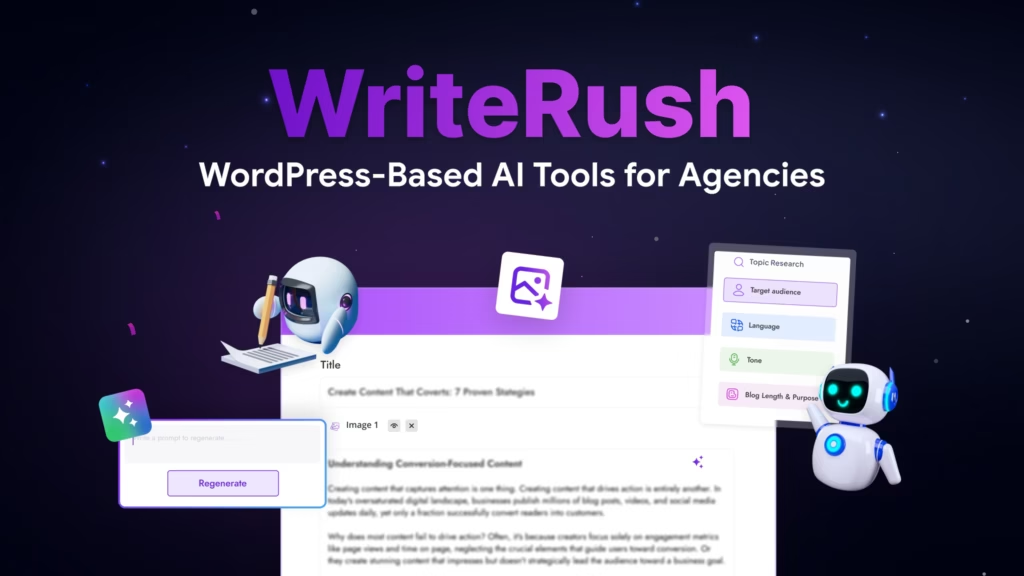
WriteRush is designed for teams that want AI-assisted writing and optimization inside WordPress instead of managing the entire content process across disconnected tools.
For agencies, this can support a workflow like:
- Plan the content topic and target audience
- Create a structured draft or content section
- Refine the tone and brand voice
- Improve headings, summaries, and readability
- Prepare content for WordPress publishing
- Keep humans involved before final approval
This makes WriteRush most useful for agencies that already publish through WordPress and want to reduce the time spent moving content between writing tools, editors, and the CMS.
AI should not replace your content team. But when it works inside the publishing workflow, it can help your team produce, improve, and update content with less friction.
How to Measure AI ROI in a Marketing Agency
Agencies should measure AI based on business impact, not just speed.
Useful AI performance metrics include:
| Metric | What it tells you |
|---|---|
| Content production time | Whether AI is reducing manual workload |
| Editing time | Whether AI drafts are actually useful |
| Organic traffic | Whether AI-assisted content attracts visitors |
| Click-through rate | Whether titles and snippets are improving |
| Conversion rate | Whether content or campaigns drive action |
| Content refresh gains | Whether updated pages recover traffic |
| Client reporting time | Whether account managers save time |
| Client retention | Whether AI improves service quality |
| Profit margin | Whether workflows become more efficient |
The goal is not simply to create more. The goal is to create better work with less wasted effort.
And when everything comes together, strategy, workflow, tools, and balance, it’s time to zoom out and look at the bigger picture of where AI is taking agencies next.
Final Thoughts
So, where does all of this leave us?
When you really understand how marketing agencies use AI, one thing stands out: AI isn’t a shortcut, and it’s definitely not a replacement for human expertise. Instead, it’s becoming a reliable partner that helps agencies think more clearly, move faster, and scale with confidence.
The agencies winning today are using AI to better understand search intent, strengthen semantic SEO, and build real topical authority, not just pump out more content. As search shifts toward Google AI Overviews (SGE) and zero-click searches, they’re doubling down on clarity, structure, and trust through E-E-A-T and meaningful information gain.
At the same time, they’re keeping humans in control with human-in-the-loop (HITL) workflows and integrating AI directly into WordPress using CMS automation, API integration, and JSON-LD.
In the end, AI doesn’t change what agencies do; it helps them do it better. And that’s exactly how smart agencies stay ahead.
Frequently Asked Questions (FAQs)
How do marketing agencies use AI?
Marketing agencies use AI for audience research, content planning, SEO, content drafting, ad copy testing, email marketing, reporting, personalization, content refreshing, and internal workflow automation.
Can AI replace marketing agencies?
AI cannot fully replace marketing agencies because clients still need strategy, positioning, creative direction, campaign judgment, brand understanding, and accountability. AI can support agency work, but humans still lead the most important decisions.
Is AI-generated content good for SEO?
AI-assisted content can perform well when it is useful, accurate, original, and reviewed by humans. Low-quality AI content that repeats generic information or lacks expertise is unlikely to perform well over time.
How do agencies use AI for SEO?
Agencies use AI for keyword clustering, search intent analysis, content briefs, on-page optimization, internal link suggestions, content refresh planning, FAQ creation, schema suggestions, and performance analysis.
How can agencies maintain quality when using AI?
Agencies can maintain quality by using clear briefs, brand guidelines, original client inputs, expert review, fact-checking, editing, and human approval before publishing.
What agency tasks should not be fully automated with AI?
Agencies should not fully automate final strategy, client recommendations, expert claims, sensitive content, brand positioning, legal or financial advice, or final publishing approval. These tasks require human judgment.
Why is content refreshing a good AI use case?
Content refreshing is a strong AI use case because many websites already have pages that could perform better with updated information, clearer structure, stronger examples, improved metadata, and better internal links.
Why do agencies use AI inside WordPress?
Agencies use AI inside WordPress because it reduces tool switching and helps teams draft, edit, optimize, and prepare content closer to where publishing happens.
How should agencies measure AI success?
Agencies should measure AI success with production time, editing time, content quality, organic traffic, conversions, reporting efficiency, content refresh gains, client satisfaction, and profitability.
What is the best way for a small agency to start using AI?
A small agency should start with one repeatable workflow, such as content briefs, blog refreshes, email drafts, or reporting summaries. Once the process works, the agency can expand AI into other parts of the workflow.
This page was last edited on 7 May 2026, at 5:56 pm